




ASD.host: Simplifying Service Exposure for Modern Developers
In modern software development, speed is everything. Teams iterate quickly, deploy continuously, and collaborate across multiple environments. But despite all the innovation in tooling, one persistent challenge remains: securely exposing local services without turning infrastructure into a headache. That’s where ASD.host steps in. ASD.host is a developer-focused platform built to make local service exposure secure, […]
In modern software development, speed is everything. Teams iterate quickly, deploy continuously, and collaborate across multiple environments. But despite all the innovation in tooling, one persistent challenge remains: securely exposing local services without turning infrastructure into a headache.
That’s where ASD.host steps in.
ASD.host is a developer-focused platform built to make local service exposure secure, structured, and effortless. Instead of patchwork tunnel solutions and rushed staging deployments, it offers a cleaner way to share and validate running services.
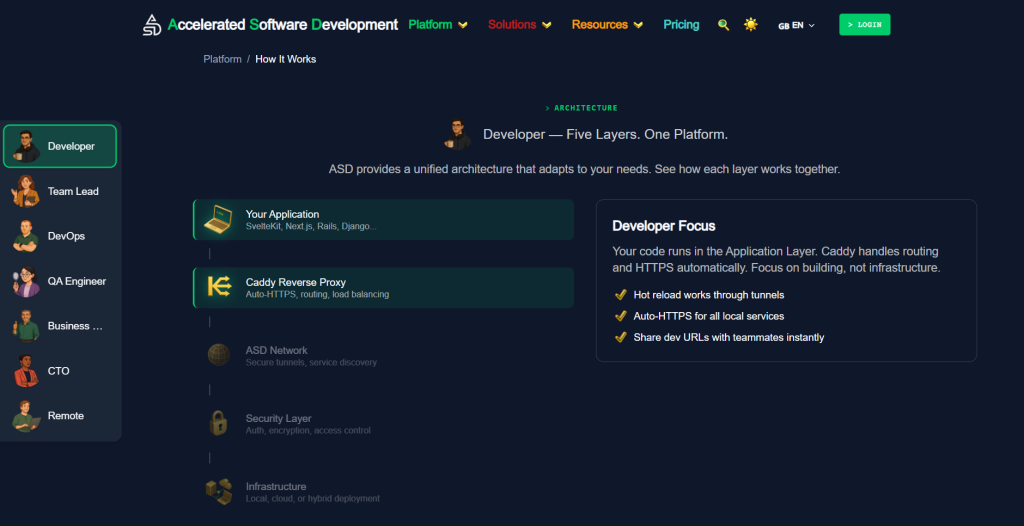
The Development Bottleneck Nobody Talks About
It’s a familiar scenario:
You’re building a feature locally.
A client needs to see it.
A webhook needs to be tested.
CI needs to hit a real endpoint.
Suddenly, you’re configuring ports, tweaking firewall rules, or deploying unfinished work just to make it accessible.
ASD.host eliminates that friction. With a streamlined workflow, developers can expose services running on their machines and make them securely accessible in seconds — without compromising structure or security.
Built for Real-World Engineering Workflows
ASD.host isn’t just a convenience tool. It’s designed to fit naturally into professional development environments.
The platform supports:
- Instant HTTPS exposure of local services
- Secure access via token-based authentication
- Clean routing without manual reverse proxy setup
- Predictable, repeatable workflows
This means fewer configuration errors and less time spent troubleshooting access issues.
Strong CI/CD Integration
One of the most compelling aspects of ASD.host is how well it integrates into CI/CD processes.
Instead of pushing code to staging just to test external integrations, teams can:
- Expose services during pipeline runs
- Validate callbacks in real time
- Debug issues directly in live workflows
- Reduce deployment bottlenecks
This shortens feedback cycles and improves release confidence.
Faster validation leads to faster shipping.
Structured Collaboration for Teams
As teams grow, chaos grows with them. Multiple developers exposing services independently can create inconsistencies and security risks.
ASD.host addresses this with structured access control and organized exposure management. Services aren’t just shared — they’re shared responsibly.
This makes it a strong fit for startups scaling their engineering teams, as well as established organizations optimizing internal workflows.
Focused, Practical, Developer-First
ASD.host doesn’t try to replace your cloud provider. It doesn’t attempt to rebuild your infrastructure stack. Instead, it focuses on solving one very specific problem — and solving it well.
Secure, reliable, repeatable service exposure.
That focus is what makes it valuable.
Final Thoughts
In a development landscape defined by speed and collaboration, eliminating friction can have a massive impact.
ASD.host offers a modern approach to exposing and validating services without unnecessary complexity. By integrating seamlessly into local workflows and CI/CD pipelines, it helps teams move faster while staying organized and secure.
For developers who want cleaner workflows and fewer infrastructure distractions, ASD.host delivers exactly what’s needed — and nothing that isn’t.
Read These Next

Why Some Real Estate Listings Get More Attention Than Others
Every real estate agent has experienced it. Two properties may be similar in size, price, and location, yet one receives…

International Women’s Day Studio Session for Moms & Moms-to-Be
March 8th is about honoring strength, beauty, and the powerful journey of womanhood. International Women’s Day gives every woman a…

March 8th: A Day to Celebrate and Appreciate Women
International Women’s Day on March 8th is a powerful reminder to recognize the women who inspire, lead, nurture, and support…